
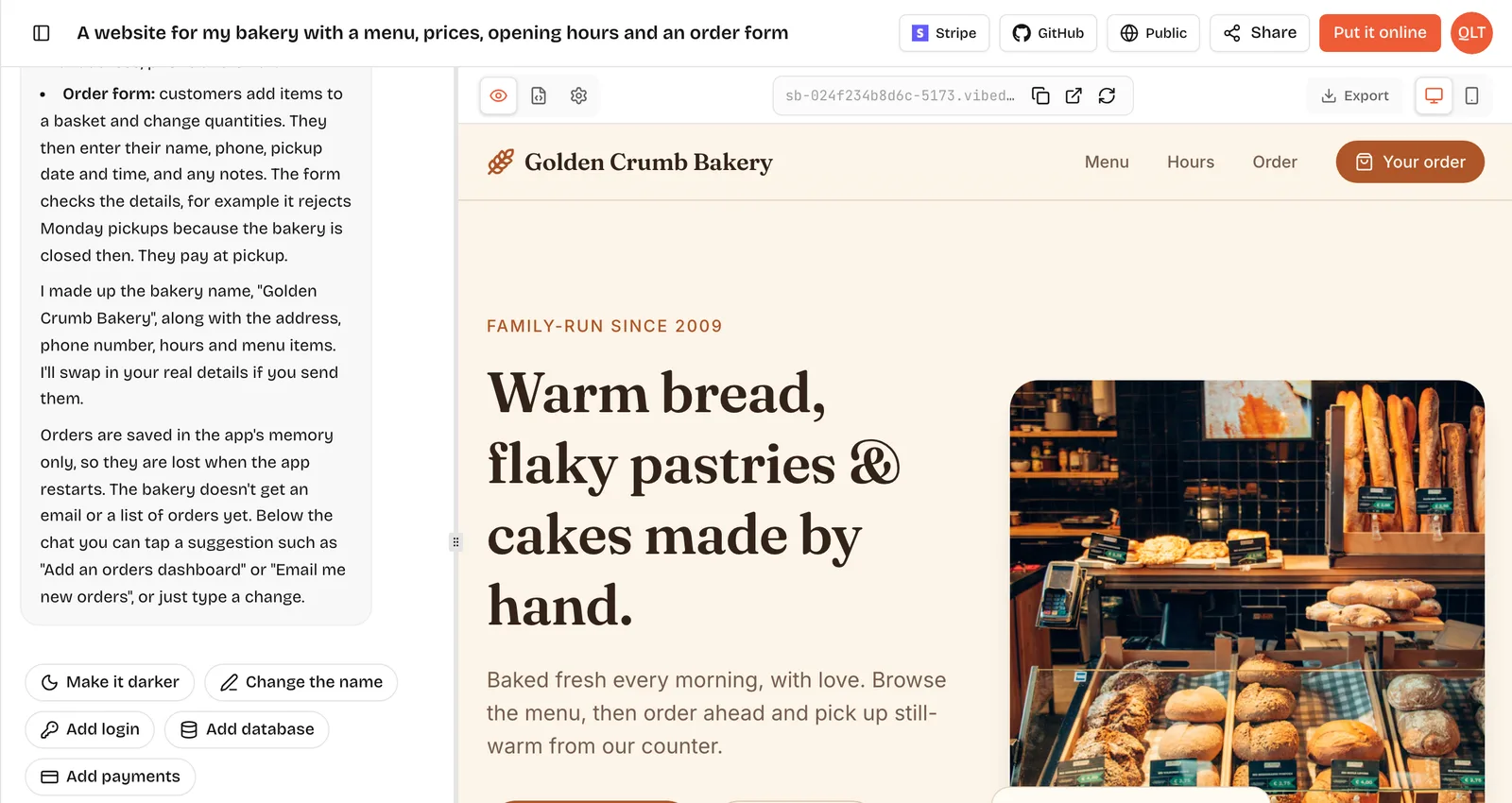
An MVP, short for minimum viable product, is the smallest version of a product that real people can actually use, built to learn whether the idea is worth more time and money. It solves one problem for one kind of user, well enough that they would come back or pay. Everything else waits. The goal is evidence, fast, before you spend months on features nobody asked for.
Frank Robinson coined the term around 2001, and Eric Ries made it famous in The Lean Startup. Today AI app builders have shrunk the build part from months to days, which makes the learning part matter even more.
MVP vs prototype vs MLP
Three terms get mixed up.
- Prototype: a mock-up or clickable demo used to test an idea or a design. It may not work at all behind the screens. You show it to people and watch their reactions.
- MVP: a working product with the fewest features that still delivers the core value. Real users can sign up, use it and, ideally, pay.
- MLP, minimum lovable product: an MVP with extra care on the experience, so the few features it has feel delightful. Some founders prefer this framing in crowded markets where a merely viable product will not stand out.
In practice, the line between MVP and MLP is about polish, not features. Keep the feature list minimal either way, and spend any extra time making the one main flow feel good.
What goes in version one
A useful MVP answers one question: will this specific group of people use this to solve this specific problem? Build only what is needed to answer it.
Put in:
- The one core action. For a booking app, booking a slot. For a habit tracker, ticking off today's habit.
- The minimum around it to make that action real: a way to sign up or identify the user if needed, a way to see the result, and a way to get it back next time.
- A clear way to measure whether it worked: signups, repeat visits, paid orders or replies.
- A way to talk to users, such as a feedback link or your email address.
Leave out:
- Settings pages, themes and profile pictures.
- Admin dashboards beyond a simple list.
- Integrations with five other tools.
- Anything a user has not asked for.
- Scaling for thousands of users you do not have yet.
A good test: if you removed a feature, would the main question become unanswerable? If not, remove it.
Build it with AI, a weekend plan
Here is a realistic plan for a solo founder using an AI app builder. The example is a booking MVP for a mobile dog groomer, built on VibeDream, where apps are React + FastAPI.
Friday evening, one hour
Write down the user, the problem and the core action in three sentences. Sketch the three or four screens on paper. Write your first prompt from the sketch: the business, who books, the screens in order, and the look. Paste it in, or record it as a voice note, and attach a photo of the sketch.
Saturday morning
Click through the preview on a phone. Fix the main flow with short follow-up prompts, one change each: "only allow future dates", "make the Book button bigger", "show the price before confirming". Ask the AI to save bookings on the server and to list them on a password-protected admin page, with the password kept in Settings.
Saturday afternoon
Add the minimum trust signals: a short About section, contact details, a simple privacy note. Test as a stranger would: log out, try bad input, try to open the admin page without the password. Read the vibe coding security checklist.
Sunday
Tap Put it online. Pick an address such as pawsonwheels.vibedreams.ai. It costs 5 credits and usually takes 1 to 3 minutes, with HTTPS included. Scan the QR code and book a test slot from your own phone. If you have a domain, connect www.yourdomain.com with a TXT and a CNAME record. Then send the link to ten real potential customers.
Your first version may come together faster or slower than this, depending on how clear the idea is. Either way, keep most of the weekend for testing and for getting it in front of people, which is the part that matters.
Validate before you build more
An MVP only pays off if you learn from it. Decide before launch what result would make you continue, change direction or stop.
- Pick one number. Bookings per week, signups from a landing page, or the share of users who return within seven days.
- Set a threshold. "If 5 of the first 20 groomer clients book through the page within two weeks, we keep going."
- Talk to users. Five conversations teach you more than any chart at this stage. Ask what they expected, where they got stuck and what they would pay.
- Watch what people do as well as what they say. A feature everyone asks for but nobody uses is a signal too.
- Change one thing at a time, and give each change enough time to show an effect.
Only after the core action works for real users should you add the next feature, and again pick the one that most affects your main number.
Two well-known MVP stories
Two classic examples show how small an MVP can be.
Dropbox famously tested demand with a short demo video showing how file syncing would work, before the product was ready for the public. The response to the video, measured in signups for a waiting list, told the founders people wanted it.
Zappos began by testing whether people would buy shoes online at all. The founder photographed shoes in local stores and posted them on a simple site; when an order came in, he bought the pair and shipped it. No warehouse, no inventory system, just proof of demand.
Neither started with the full product. Each picked the cheapest way to answer the one question that mattered. With AI builders, your cheapest way is often a real working app rather than a video, but the principle is the same.
Common MVP mistakes
- Building for everyone. Pick one user type first.
- Hiding the MVP until it is perfect. Nobody can learn from a product they have never seen.
- Skipping the measurement. Without a number, every result feels like success.
- Collecting personal data or payments without basic safety checks.
- Treating the MVP code as disposable without checking. If it works, you may keep building on it; AI builders that give you the code, like VibeDream with ZIP export and GitHub sync, make that easier.
- Spending the budget on polish before you know people want it.
What an MVP costs
Costs swing hugely by route. An agency build usually lands in five figures; our app cost guide breaks down sourced agency, no-code and builder prices. Building it yourself with an AI app builder mostly costs a monthly plan and your time. On VibeDream that starts at $49 a month for 60 credits, with hosting included and 5 credits per publish. Plenty of founders build the MVP themselves and only hire help once the numbers justify it.