
Replit pricing has a fixed part and a metered part. The fixed part is the plan: Starter is free, Core is $20 a month ($18 billed yearly), Pro is $100 a month ($90 billed yearly) and Enterprise is custom. The metered part is everything you use: Agent work billed by effort per checkpoint, plus hosting, databases and data transfer billed by usage. Core and Pro include monthly credits that soak up the metered part first, so many small projects pay only the plan price. This guide shows where that stops being true.
Sources: replit.com/pricing and Replit's billing docs, including the cloud pricing update that took effect from August 1, 2026. Checked Oct 2026. Replit offers no public discount code that we could find. Yearly billing is the reliable saving.
What the subscription buys
- Starter (free): daily Agent credits up to a monthly cap, monthly cloud credits for databases, storage and publishing, Lite build, and one published app. That app's link goes down after 30 days, Plan Mode is not included, and deployments carry a Made with Replit badge.
- Core ($20 a month, $18 yearly): $20 of monthly credits, up to 30 hours of chat and up to 60 projects on Free Mode, Plan Mode, unlimited workspaces and AI integrations. Unused credits reset every cycle.
- Pro ($100 a month, $90 yearly): everything in Core plus $100 toward the most capable models, more Free Mode use, 10 parallel agents, 15 collaborators, 50 viewers, 28-day database rollback and premium support. Unused credits carry over for two months.
- Enterprise (custom): SSO, SCIM, audit logs, advanced privacy controls, and single-tenant or private networking options.
Replit's help docs say the monthly credits apply to Agent usage, deployments, storage and other usage-based services. Free Mode is separate: on Core and Pro it covers everyday Agent chat without touching those credits, up to its allowance.
What the meters add on top
Agent work outside Free Mode is effort-based. When the Agent finishes a request in Build Mode it creates a checkpoint, and the checkpoint is priced by how complex the request was. Replit asks you to confirm before a paid action starts, shows each checkpoint's cost when you hover over the usage icon, and gives every subscriber some one-time free checkpoints. What it does not publish is a price per checkpoint. Plan Mode can be charged for reasoning that changes no code, and when the Agent calls Claude, ChatGPT or Gemini for you, those calls are billed at the provider's public API rate.
- Autoscale deployments: $0.60 per million compute units, where 1 CPU second is 18 units and 1 GB-second of memory is 2 units, plus $0.40 per million requests and a small monthly base fee. Apps sleep after 15 minutes without traffic.
- Reserved VMs that never sleep: from about $15 a month for a shared 0.5 vCPU with 2 GiB, $35 for a dedicated 1 vCPU with 4 GiB, and $130 for 4 vCPU with 16 GiB.
- Static sites: hosting is free, data transfer is charged.
- Outbound data: $0.05 per GiB.
- Production Postgres: $0.16 per hour while the database is active, plus $0.35 per GiB stored each month. A database counts as active while it receives requests and for 5 minutes after the last one.
That last rule matters more than any other line on this page, as the second example below shows.
Bill one, a weekend prototype
You want to try an idea over a weekend and show it to three friends. Starter covers this for $0: the daily Agent credits are enough for a small build, and the one published app stays up for 30 days. The catches are that you cannot use Plan Mode, the badge stays on, and the link dies after a month. If the idea survives the weekend, one month of Core at $20 removes all three limits. Total: $0, or $20 if you keep going.
Bill two, a small app left running
Now say you keep a small booking app online on Core with an Autoscale deployment and a Postgres database. The figures below are our estimate from Replit's published rates, not a measured bill. We assume a 1 vCPU, 2 GB machine that is awake about 4 hours a day, a database that is active for the same 4 hours, 1 GiB of data and 5 GiB of outbound traffic.
- Compute: 120 awake hours is 432,000 seconds. That is about 7.8 million CPU units plus 1.7 million memory units, roughly $5.70.
- Requests: 30,000 in a month, about one cent.
- Database: 120 active hours at $0.16 is $19.20, plus $0.35 for storage.
- Outbound data: 5 GiB at $0.05 is $0.25.
- Base fee: a dollar or two.
That comes to about $26 to $27 of usage. Core's $20 of credits covers most of it, so the bill is roughly $20 plus $6 or $7, and that is before any Agent work you approve that month. Notice where the money goes: the database, not the app. If your traffic is a trickle spread across the whole day, with a request every few minutes, the database never reaches its 5 idle minutes and stays active around the clock. At 720 hours that line alone would be about $115. For apps like that, a Reserved VM at around $15 a month plus careful database use is often cheaper, and it is worth checking the usage dashboard in week one.
Bill three, an active build month
This is the one nobody can price in advance, Replit included. If you build every evening for a month, much of the chat happens in Free Mode, but larger requests such as adding payments or a dashboard run as paid checkpoints. On Core, those draw down the same $20 that pays for hosting. Once it is gone, further usage is charged on top or covered by credit packs you buy.
- Use Replit's interactive estimator at agent-pricing.replit.app, which prices sample apps.
- Set a usage limit and budget, described in Replit's Managing your spend docs.
- Ask for one checkpoint per request so work is not split into several charges.
- If you regularly spend more than about $80 of usage on Core, compare Pro: $100 of credits, rollover for two months and 10 parallel agents.
A realistic range for a heavy month is therefore $20 plus whatever you approve on the cost screen. That is honest but not satisfying, and it is the main reason some people move to tools with a flat fee. Our Replit review weighs that trade-off, and Replit alternatives lists the flat-fee options.
A flat-fee comparison point
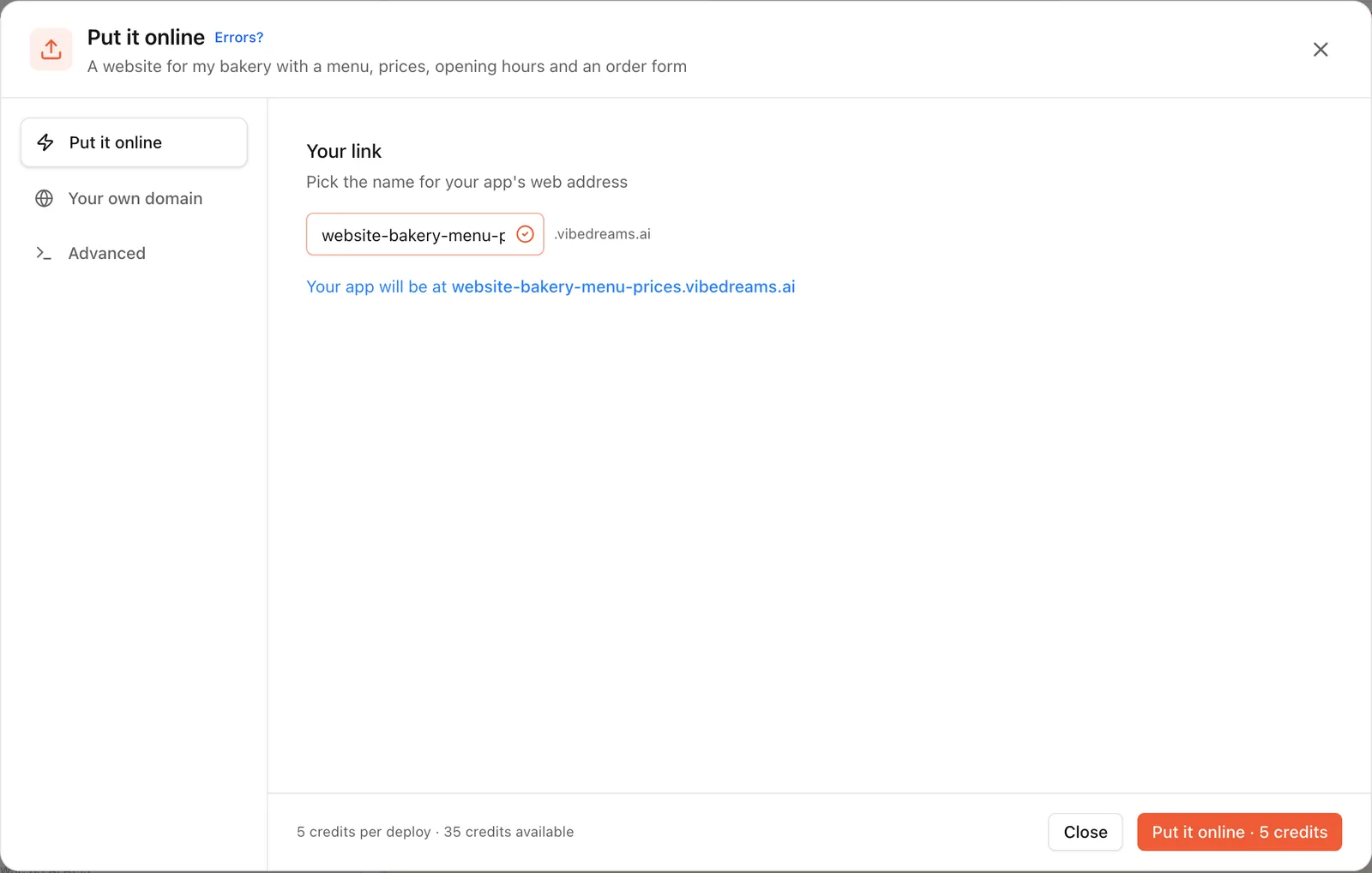
If you do not need Replit's range of languages, it helps to see a different model. VibeDream has no free plan. All Access Mini is $49 a month with 60 credits and 3 active projects, and All Access is $97 with 150 credits and 5 projects. Building uses credits, and putting an app online costs 5 credits each time you publish or update. Hosting, HTTPS and a your-app.vibedreams.ai address are included under a fair usage policy, so there is no compute, database-hour or data-transfer line. Extra credits come in packs, from 50 for $30 to 1,000 for $399.
The trade-off runs both ways. Replit starts cheaper and lets you code in almost anything. VibeDream costs more up front and only builds React plus FastAPI apps and Phaser games, but the monthly number does not move with traffic. Publishing often adds up too: ten updates in a month is 50 credits. Full plan details are on the VibeDream pricing page, and the deployment guide shows what one publish includes.