
If the Agent bill sent you looking, the best Replit alternatives are tools with a fixed subscription, such as Claude Code or Cursor. If you want to work on your own machine, Cursor, GitHub Copilot or Devin Desktop. If you never wanted to code, an app builder like VibeDream, Lovable or Base44. If you need an App Store app, look at FlutterFlow or Rork, though Replit can do that too. Each section below takes one reason and names the pick.
Prices come from each vendor's official pricing page, checked Oct 2026. Several vendors changed plans this year, so confirm before you pay.
Your Agent bill is hard to predict
This is the most common reason. Replit charges paid Agent work per checkpoint, scaled to how complex each request was, and it does not publish a fixed price per checkpoint. Plan Mode can be billed for reasoning that changes no code, and calls the Agent makes to outside models are charged at the provider's API rate. Hosting then adds compute, requests, database hours and data transfer. Core's $20 of monthly credits covers all of it until it does not.
- Claude Code: included in Claude Pro at $20 a month ($17 billed yearly) and in Max from $100 a month. When you hit the plan's usage limit you wait for it to reset, unless you choose to pay for extra usage.
- Cursor: a ladder of fixed plans from the entry Plus tier up to Premium at $30, Super at $100 and Ultra at $200 a month, each a set multiple of the Plus allowance (4x, 15x and 50x).
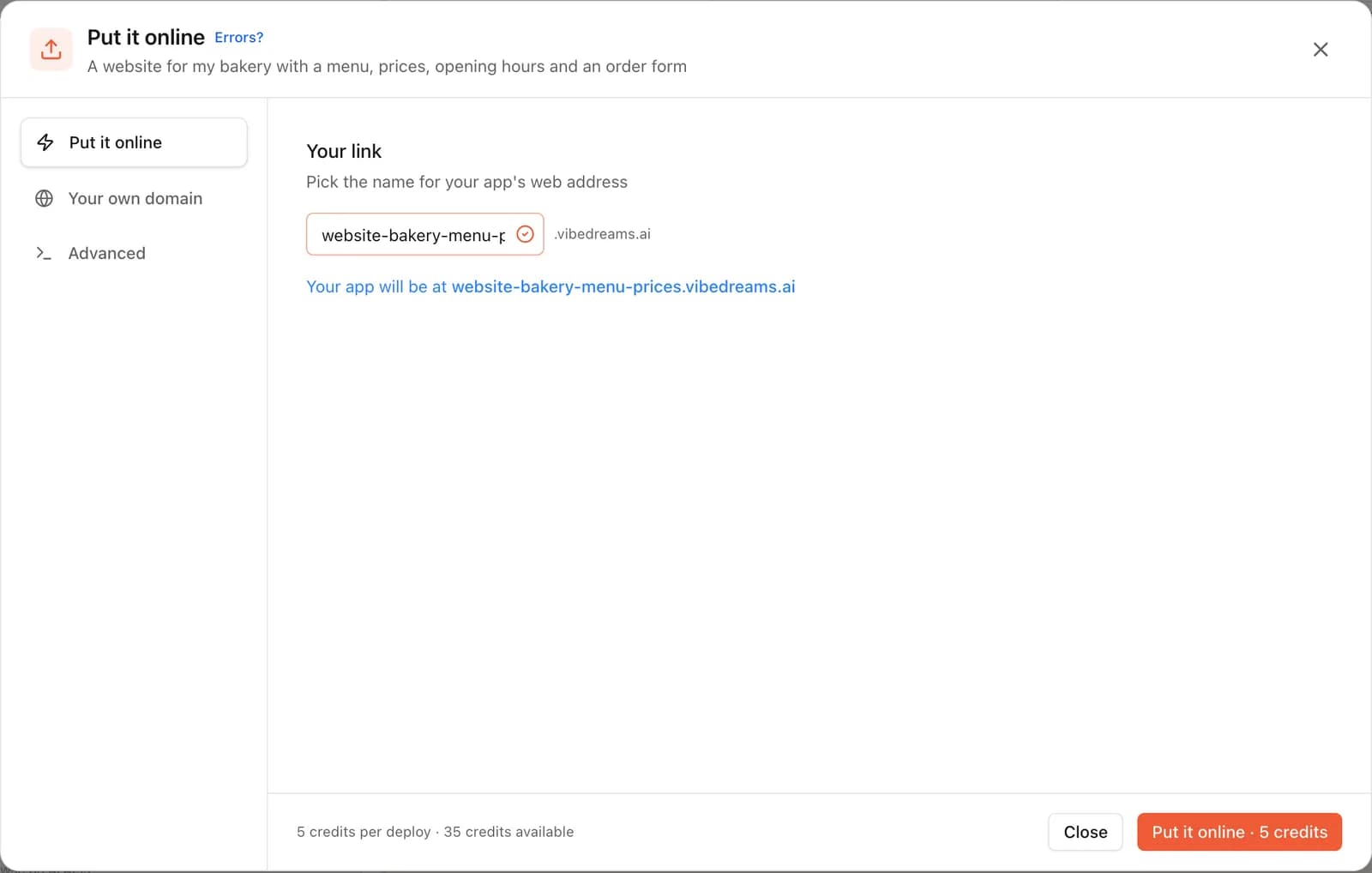
- VibeDream, if you also want hosting in the price: All Access Mini is $49 a month with 60 credits. Publishing costs 5 credits each time, and hosting is included under a fair usage policy, so traffic does not create a second bill.
Before you switch, try one thing. Replit has a usage limit and budget setting under Managing your spend, and Pro credits roll over for two months. If your problem is surprise rather than total cost, a limit may be enough. Our Replit pricing guide shows what typical bills look like.
You want a real editor on your own computer
Replit's editor runs in the browser, which is great on a Chromebook and less great when you have a large repository, local tools and keyboard habits built over years. Developers in this camp usually want the AI inside a desktop editor and are happy to choose their own host.
- Cursor is the default pick. It is a VS Code-style editor with an agent that reads the whole project and edits across files.
- Devin Desktop is the editor that used to be called Windsurf, now owned by Cognition. Pro is $20 a month and adds access to Devin's cloud agents.
- GitHub Copilot is the cheapest way to keep the editor you already use. Pro is $10 a month and includes the cloud agent that you can assign tasks to.
- Claude Code suits people who live in a terminal.
The trade-off is that hosting becomes your job again. Budget an hour to set up a host and a database the first time. We compare these editors in more detail in Cursor alternatives.
You never wanted to write code
Plenty of people open Replit because it is famous, then find themselves reading package errors. If you want the app and not the workspace, use a chat-first app builder. You describe the idea, the tool builds it, and you put it online without choosing a deployment type.
On VibeDream you type, record a voice note or add a screenshot, and a live preview starts within seconds at phone and desktop size. Apps are React with a FastAPI backend in Python. Games are built with Phaser. You can still read every file in the built-in editor, download a ZIP or sync to GitHub, so leaving later is not a rewrite.
- Lovable, if interface polish matters most. It has a free tier and a managed backend called Lovable Cloud.
- Base44, if you are building an internal tool and want users and data handled for you.
- Bolt.new, if you like seeing the project files while you chat.
You need an app in the App Store
Be careful here, because Replit may already do what you need. Its docs show the Agent building a React Native app with Expo, previewing it on your phone in Expo Go, then moving to TestFlight and App Store submission. You need an Apple Developer membership, and Google Play publishing is a manual step for now.
- FlutterFlow, for a visual editor that produces Flutter code and handles both stores. See FlutterFlow alternatives for the trade-offs.
- Rork, for chat-to-native building aimed at people who do not code.
- Adalo, for drag-and-drop screens with its own database.
VibeDream is not an option for this reason. It builds web apps that work in a phone browser, and you can open your live app on a phone with a QR code, but it does not produce native iOS or Android apps.
You want a Python backend with fewer meters
Some people like Replit for Python and dislike everything around it: picking between Autoscale and Reserved VMs, paying for database hours, watching egress. Two builders produce a React front end with a FastAPI backend, which is what many Replit Python projects end up as anyway.
- VibeDream: FastAPI backend you can read, hosting and HTTPS included, a your-app.vibedreams.ai address, and your own domain through a TXT and a CNAME record on a www or subdomain address. All Access is $97 a month with 150 credits and 5 active projects. No free plan.
- Emergent: also React plus FastAPI, with hosting on its own cloud. Compare the two in Emergent alternatives.
Be clear about the limits. VibeDream does not run Go, Rust or long-running background workers, and its one-tap payments are coming soon. If your project needs any of those today, Replit or your own server is still the better home.
What to export before you cancel
- Push the project to GitHub or download it from Replit.
- Dump your production Postgres database. It is standard Postgres, so pg_dump works.
- Copy every key out of the Secrets panel into a password manager.
- Note your custom domain's DNS records so you can repoint them.
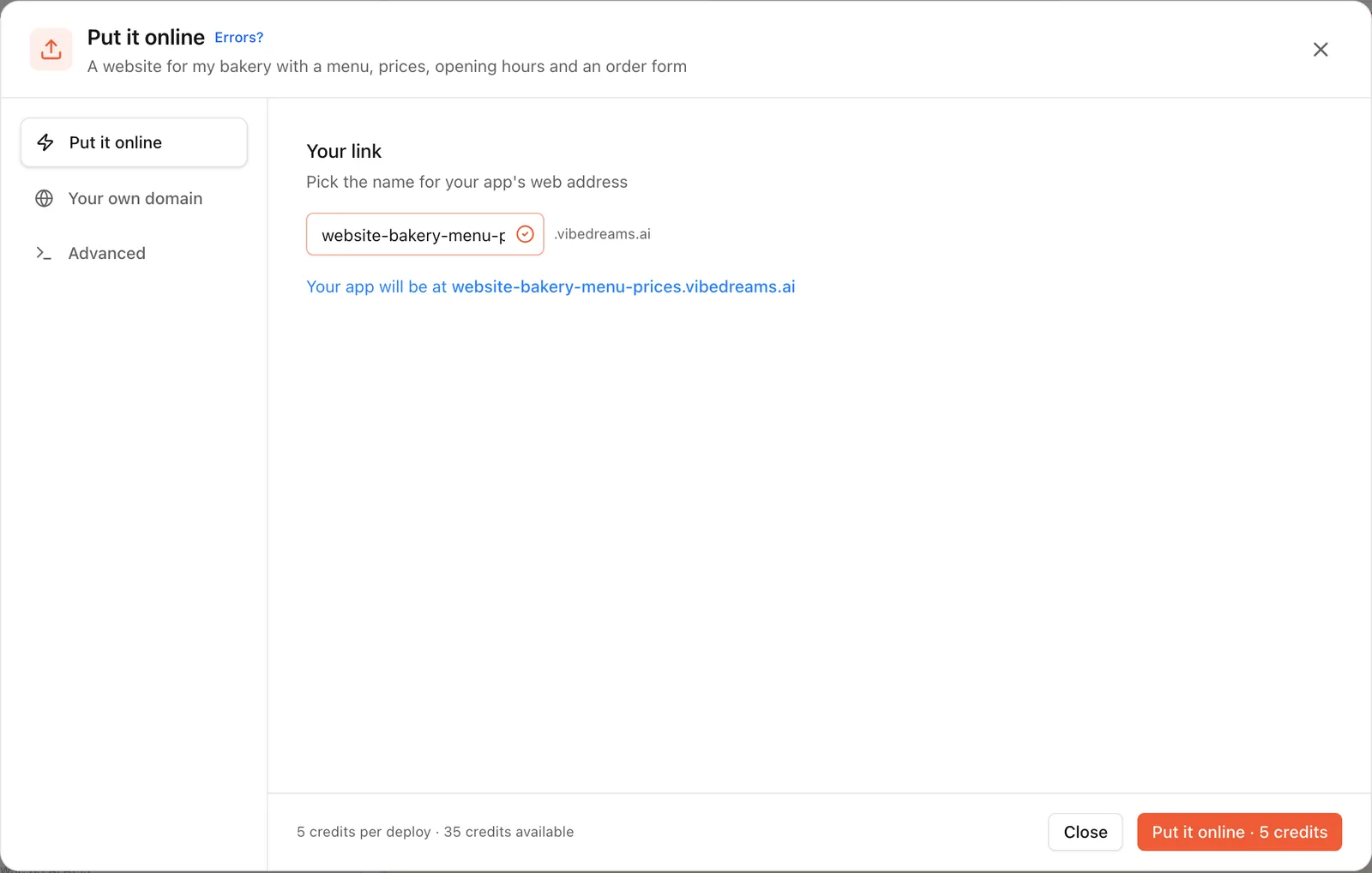
- Moving to an editor: clone the repository and pick a host. Moving to VibeDream: describe the app in the chat, attach screenshots of each screen, add keys under the gear (Settings) above the preview, then follow the deployment guide to put it online.