
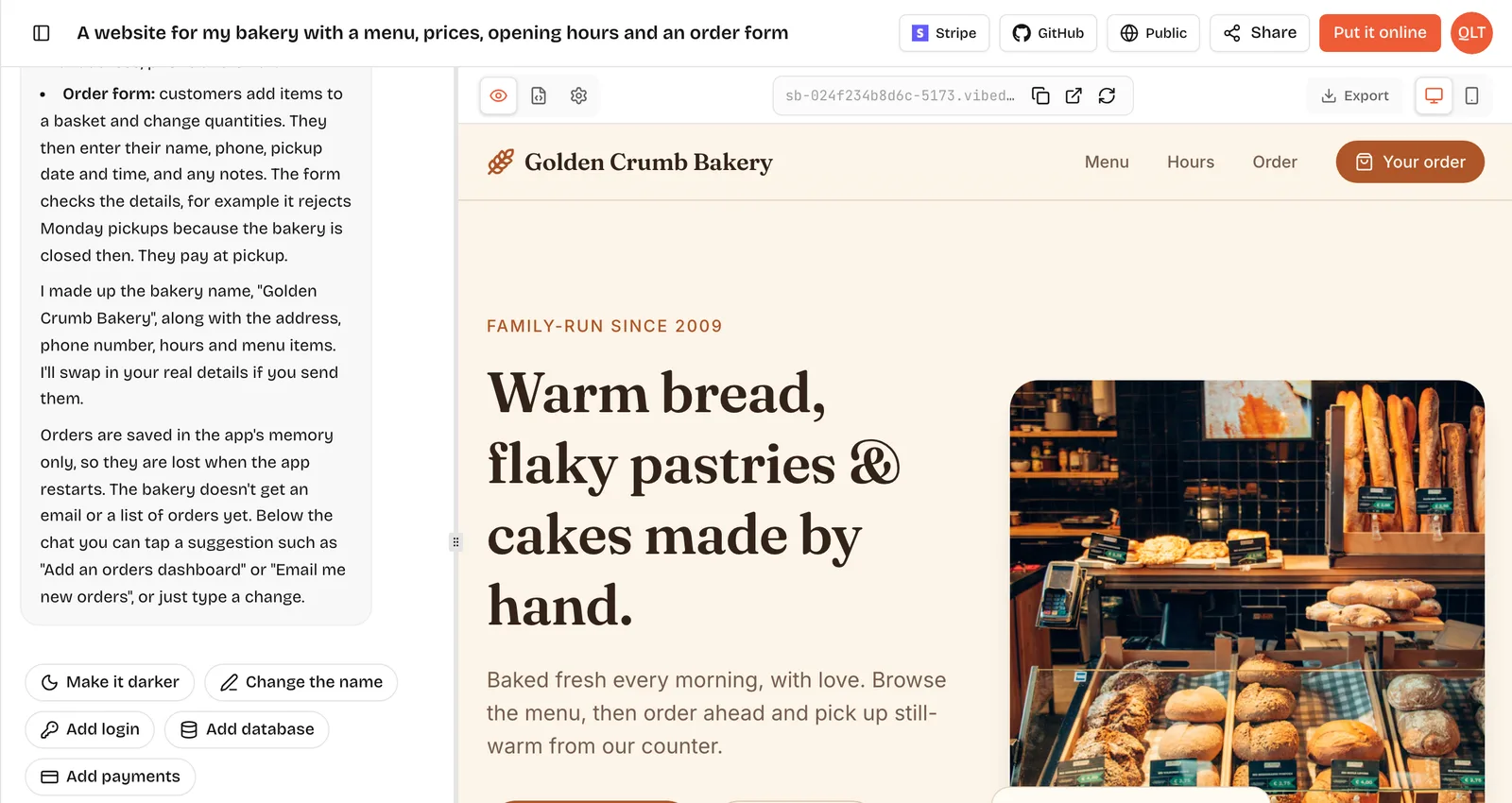
Each of the good v0 alternatives fills a gap that v0 leaves you to close yourself. If you need a backend you can read, VibeDream or Replit. If you need saved data without connecting a database provider, Lovable, Bolt.new or Base44. If you want hosting that is not tied to Vercel's plans, VibeDream, Bolt.new or Lovable include it. If the problem is cost per seat, Lovable charges no seats. And if what you love is v0's interface quality, the honest answer is to stay on v0.
v0 is excellent at React and Next.js interfaces, which our Vercel v0 review rates job by job. Its Free plan allows 7 messages a day and Plus is $30 per user a month with $30 of credits. The gaps below are the ones that send people looking. Prices are from each vendor's official pricing page. Checked Oct 2026.
Gap one, a backend you can actually read
v0 can generate server code in Next.js and call external APIs through environment variables, so it is not screens only. The friction is that the server side runs as Vercel functions next to a separate database account, and a non-developer has to reason about both.
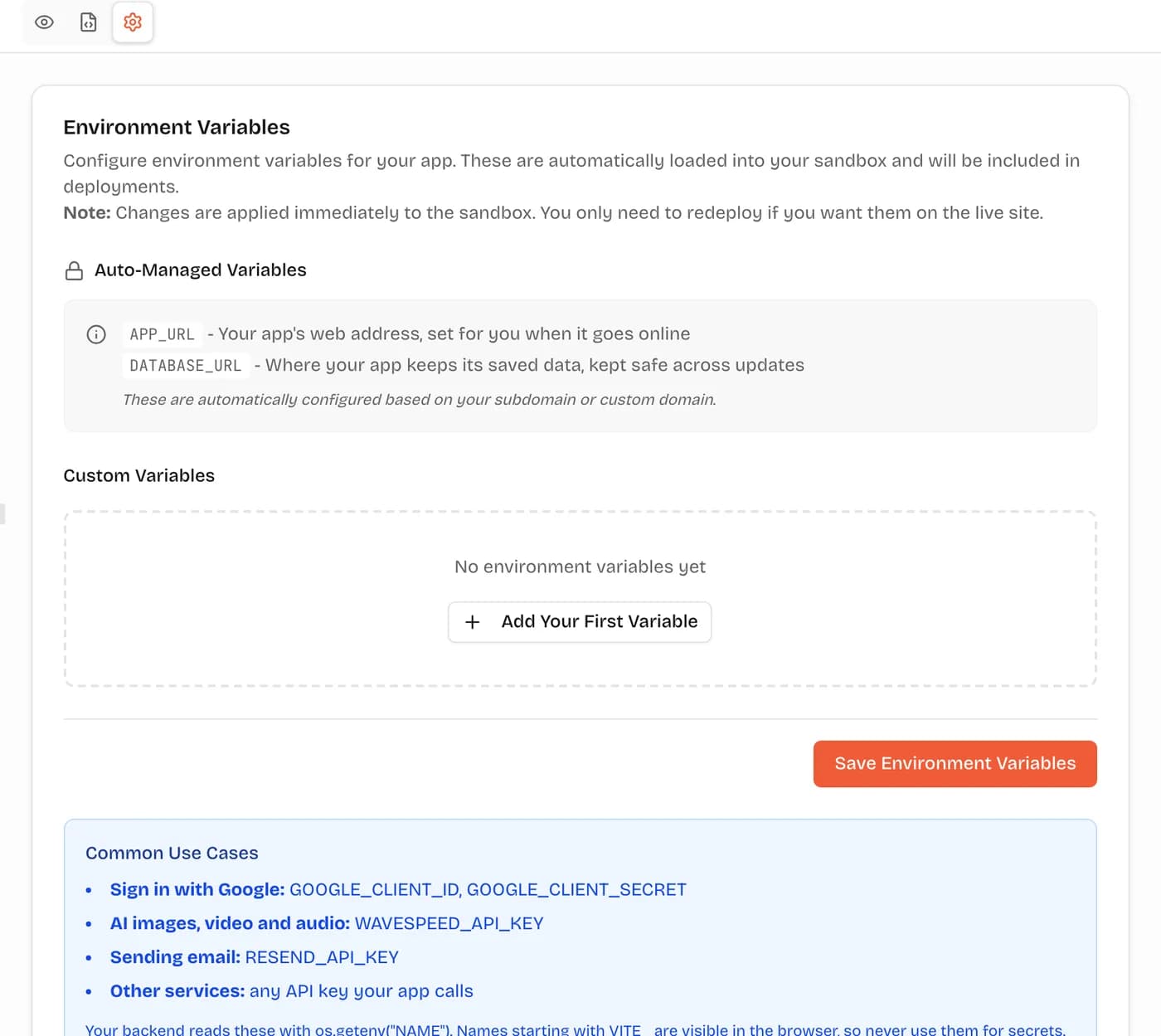
VibeDream takes the other approach, and we make it, so check the claims. Every app gets a React front end and its own FastAPI server in Python, written by the AI and visible file by file in the built-in code editor. You can ask for a route that saves form entries, calls a service with your API key or processes an upload, and then open the file to see what it does. Keys go under the gear (Settings) above the preview, and any name starting with VITE_ is visible in the browser, so keep secrets without that prefix. The environment variables guide shows the screen.
If you want to write the backend yourself, in any language, Replit is the better fit. Core is $20 a month ($18 billed yearly) with usage credit for its models, and you get a full workspace rather than a builder.
Gap two, data that saves without a second account
v0's docs describe one-click database setup with Neon, Supabase, Upstash or Vercel Blob. It works, but the data then lives in that provider's account with its own limits and bill. Three builders keep it inside the product instead.
- Lovable: Lovable Cloud adds a database, sign-ins, file storage and server functions, built on Supabase's open-source foundation. Usage comes out of your credit balance after a 20-credit monthly Cloud grant. Pro starts at $25 a month.
- Bolt.new: even the Free plan lists unlimited databases, and Pro adds expanded database capacity and a choice of database provider. Pro is $18 a month billed yearly for 10M tokens.
- Base44: tables, users and roles are set up for you, which suits internal tools best. Starter is $16 a month billed yearly for 100 message credits. Read our Base44 review for the portability caveat.
VibeDream's built-in login and database work with one tap, and its one-tap payments are coming soon. File storage is built in today, with 25GB on All Access Mini and 1TB on All Access, using short-lived signed links for uploads.
Gap three, hosting that is not tied to Vercel
v0 deploys to Vercel in one click, which is great until you read the hosting terms. Vercel's Hobby plan is $0 but its FAQ says it is for personal, non-commercial use, and Pro is $20 a month per developer seat with $20 of included usage. A business site on v0 therefore usually means v0 Plus plus Vercel Pro.
The alternatives bundle hosting into the plan. On VibeDream, Put it online costs 5 credits per publish or update, and hosting, HTTPS and a your-app.vibedreams.ai address are included under a fair usage policy. Your own domain takes a TXT and a CNAME record on a www or subdomain address; root domains are not supported yet. The deployment guide walks through it. Bolt.new hosts sites on every plan, with Bolt branding on Free and your own domain without branding on Pro. Lovable publishes publicly on Pro.
Gap four, a bill you can predict
v0 charges per user and meters usage in tokens, counting your prompt, uploads and chat history as input. A long debugging thread costs more than a short UI request, and a five-person team on Plus is $150 a month before hosting. That is fair pricing for heavy users, but hard to forecast.
- Lovable has no per-seat pricing; workspaces allow unlimited members on one credit balance.
- Bolt.new Teams is $27 per member a month billed yearly, a little under v0 Plus, still per seat.
- VibeDream is a flat monthly plan per account: $49 for 60 credits or $97 for 150, plus 5 credits per publish, with credit packs from 50 credits for $30 if you run out. There is no free plan, so the floor is higher than v0's.
If you are a solo builder on a tight budget, v0 Free and Lovable Free are cheaper places to start. Predictability matters more once an app is live and you are paying for it every month.
Gap five, design-to-code fidelity
This is the one gap most people do not have with v0. It turns screenshots and Figma files into React built on Tailwind and shadcn/ui, lets you click elements in Design Mode to adjust them, and can learn your own components through Design Systems. We do not know of a builder that clearly beats it here.
Lovable comes closest among chat builders, with strong design defaults. VibeDream accepts a screenshot or sketch in the chat and rebuilds the layout, which is good for getting the structure right, but if pixel accuracy against a Figma file is the job, stay on v0.
When staying on v0 is the right call
- Your team already ships Next.js on Vercel and wants AI help on interfaces.
- A developer will take over the code and wire the data layer.
- You need SAML SSO and support SLAs, which v0 Enterprise offers.
- You mostly generate components rather than whole apps.
Taking a v0 project somewhere else
GitHub sync is on every v0 plan, including Free, so start by pushing the project to a repository you own. Export your data from whichever provider you connected, copy your environment variables from the Vercel project settings, and list any Marketplace integrations such as Stripe.
To rebuild in VibeDream, attach screenshots of your v0 screens, describe what each button should do and which data it saves, and the AI rebuilds the interface in React with the logic in FastAPI. Add your keys under Settings, put it online, and point your domain once everything works. For other routes, see our Lovable alternatives by project type.