
The best Bolt.new alternatives, in order: Lovable if you want the same chat-to-app feel with a different billing model, VibeDream if you want a Python backend, Replit if you want to write code in any language, v0 if the interface is the whole job, Base44 if you want sign-ins and data handled for you, and Emergent if you want a full-stack builder that also targets mobile. Most people leave Bolt for one of two reasons: token use that grows with the project, or a Node.js runtime when they wanted Python. The ranking below is ordered by how often those two reasons point to each tool.
Every price was checked on the vendor's own pricing page in Oct 2026, in US dollars. For reference, Bolt itself is Free with 1M tokens a month and a 300K daily cap, or Pro at $18 a month billed yearly for 10M tokens. The token arithmetic is in our Bolt.new pricing guide.
1. Lovable, the closest swap
Price: Free gives 5 build credits a day, up to 30 a month. Pro starts at $25 a month for 100 credits, or $250 a year. Business starts at $50 a month. Source: docs.lovable.dev, checked Oct 2026.
Why switch: Lovable works like Bolt on the surface. You chat, it writes a React app, you watch the preview, and Lovable Cloud supplies the database and sign-ins. The difference is the meter. Lovable charges credits per message, scaled by how complex the change is, rather than raw tokens, and small visual edits typically cost under one credit. Some people find that easier to budget than a token counter. Many people also prefer its default visual style.
The catch: Free projects can only be shared with up to 10 invited people, so a public launch needs Pro. Cloud and AI features inside your app draw on credit grants too, which means a busy app can compete with your building budget. Full detail in the Lovable review.
2. VibeDream, if you want Python on the server
Price: All Access Mini is $49 a month for 60 credits and 3 active projects. All Access is $97 a month for 150 credits and 5 active projects. There is no free plan.
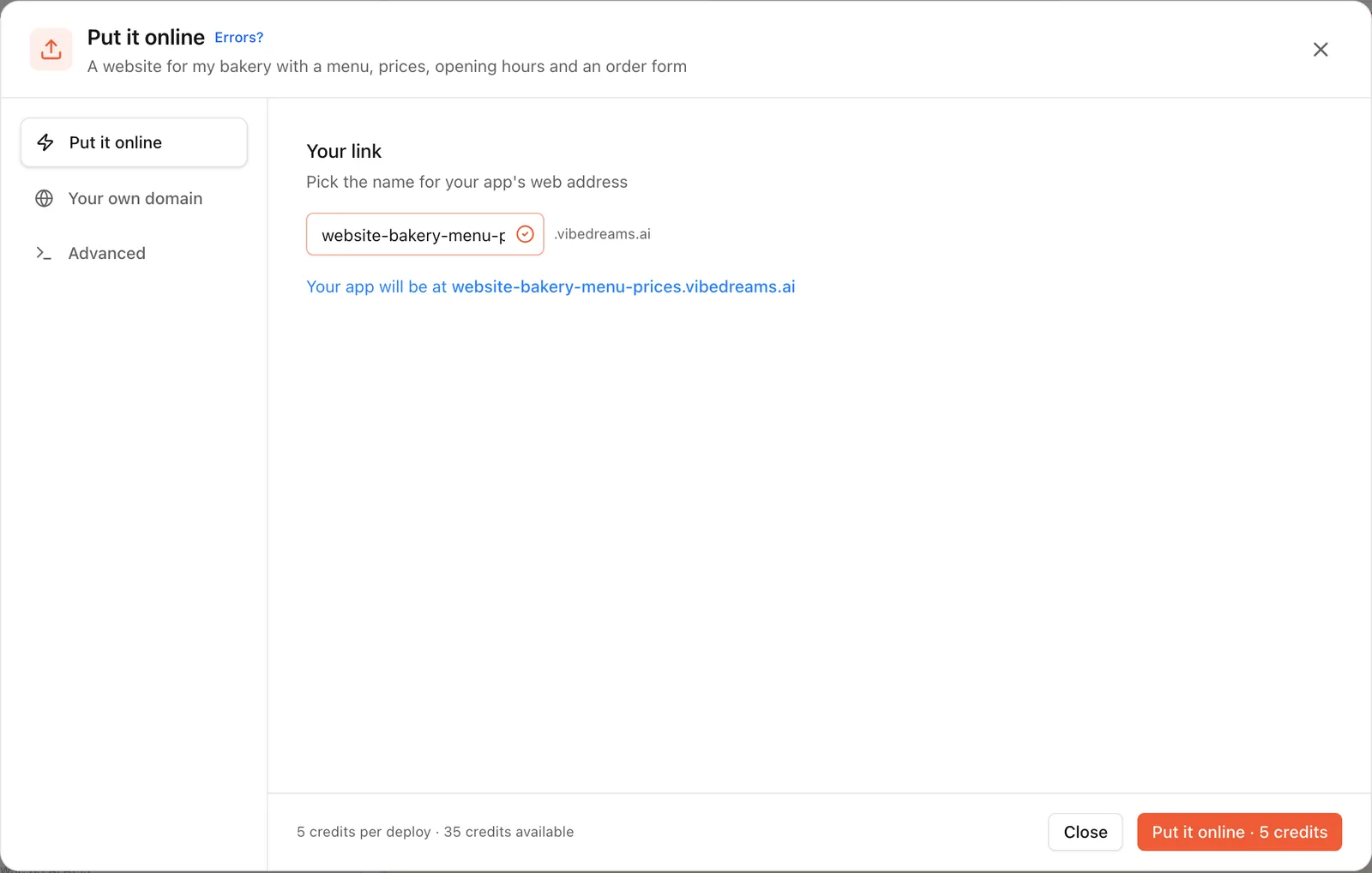
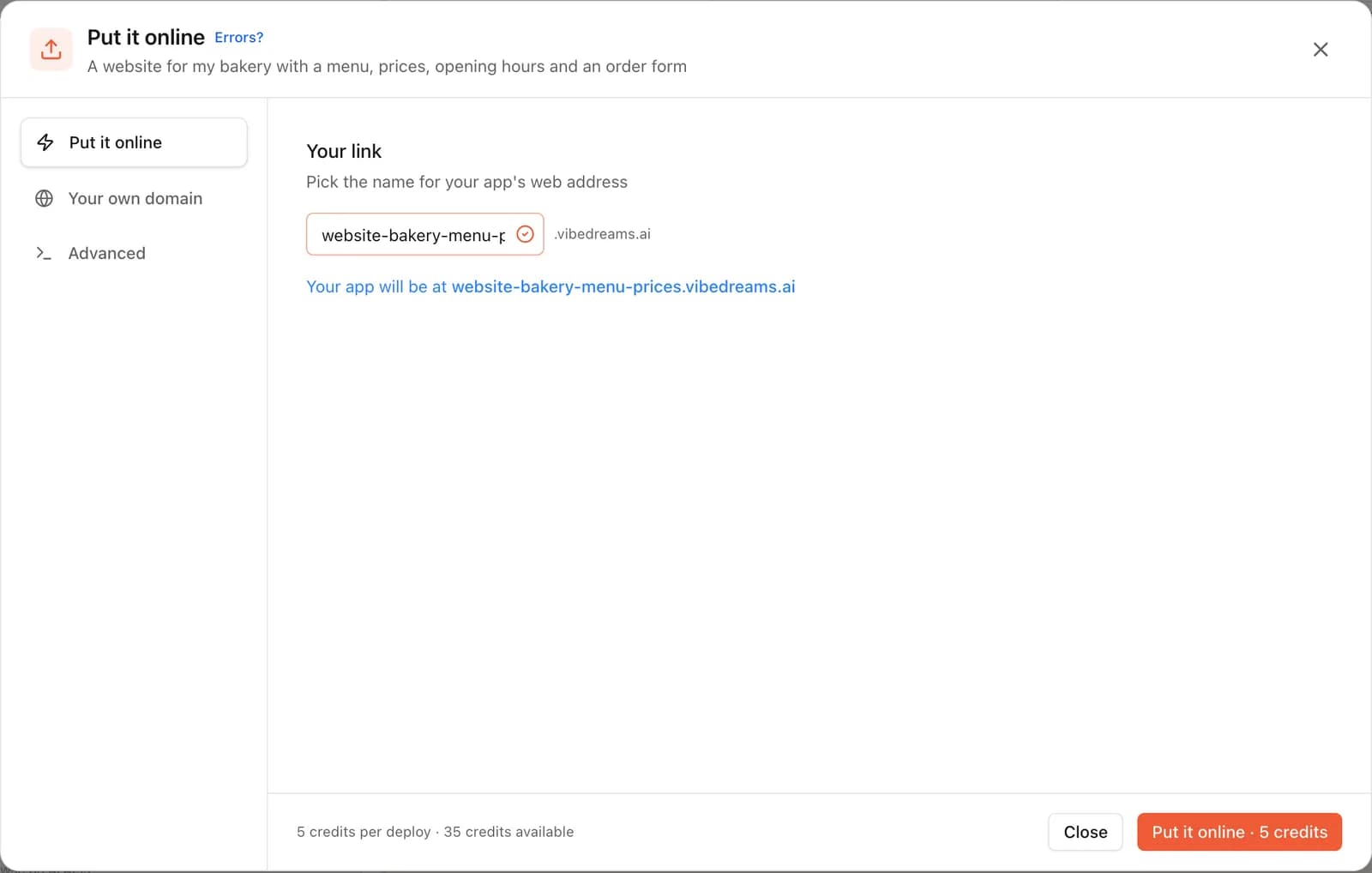
Why switch: every app VibeDream builds has a React front end and a FastAPI backend in Python, and you can read each file in the built-in code editor. That matters when your app needs a Python library, processes uploaded files, or calls another service from the server. File storage is built in, with 25GB on All Access Mini and 1TB on All Access. Putting an app online costs 5 credits each time you publish or update, and the plan includes hosting, HTTPS and a your-app.vibedreams.ai address. You can describe the app by typing, by voice note or with a screenshot, and it also builds browser games with Phaser.
The catch: it costs more to start than Bolt, which is free to try. Bolt Cloud gives you managed sign-ins and a database, and VibeDream's built-in login and database work with one tap too. One-tap payments are coming soon. It builds web apps that run in a phone browser, not App Store apps. Your own domain works on a www address or a subdomain, not a bare root domain yet.
3. Replit, if you want to write code
Price: Core is $20 a month, or $18 a month billed yearly, and includes $20 of usage toward more powerful models. Pro is $100 a month, or $90 billed yearly. The free Starter plan includes one published app whose link goes down after 30 days. Sources: replit.com/pricing and docs.replit.com, checked Oct 2026.
Why switch: Replit is a full cloud workspace. Its Agent builds the app, but you also get a real editor, a shell and almost any language, Python included. If you hit the edges of Bolt because you wanted to drop into the code and run your own commands, this is the most natural next step.
The catch: usage beyond the included credit is billed on top, so the monthly figure is a floor rather than a ceiling. Non-coders sometimes find the workspace more than they wanted. See Replit alternatives for where it sits among editors.
4. v0 by Vercel, if the interface is the product
Price: Free with a limit of 7 messages a day, deployment to Vercel and GitHub sync. Plus is $30 per user a month with $30 of monthly credits per user. Business is $100 per user a month. Source: v0.app/pricing, checked Oct 2026.
Why switch: v0 is very good at React and Next.js interfaces and hands them to Vercel in one step. If a developer will take the project over, v0's output tends to be the easiest to keep working on.
The catch: model usage is charged per token from your credits, so heavy sessions cost more, and the project is most at home on Vercel. The Free plan's 7 messages a day runs out quickly on a real build. More in the v0 review.
5. Base44, if you want sign-ins and data done for you
Price: Free with 25 message credits and 100 integration credits a month. Starter is $16 a month billed yearly for 100 message credits, Builder $40, Pro $80 and Elite $160, all billed yearly. Source: base44.com/pricing, checked Oct 2026.
Why switch: Base44 sets up authentication, a database and hosting without you thinking about them, even on Free. For an internal tool or a simple CRM that only your team uses, it is often the fastest route to something working.
The catch: you build inside Base44's platform. Check exactly what code export includes on your plan before you put a business on it. Our Base44 review covers that in detail.
6. Emergent, if you also want a mobile build
Price: Free with 10 credits a month. Standard is $20 a month, or $17 billed yearly, for 100 credits. Pro is $200 a month, or $167 billed yearly, for 750 credits. Source: emergent.sh/pricing, checked Oct 2026.
Why switch: Emergent builds full-stack apps from a prompt and runs them on its own cloud. Like VibeDream, it can produce a Python backend, and it aims at mobile apps too.
The catch: 100 credits on Standard is a small allowance for a real app, and the pricing page does not say what keeping an app live costs in credits. Ask before you budget.
Leaving Bolt without losing your work
- Get the code out first. Sync the project to GitHub or download it from Bolt.
- Get the data out. If you used Supabase, it is already in your Supabase account. If you used Bolt Database, export the rows, or on Pro claim the database into your own Supabase account.
- Write down every secret and environment variable the app uses.
- In the new tool, describe each screen and attach screenshots rather than pasting the whole codebase. In VibeDream, ask for the server logic in FastAPI and add your keys under the gear icon above the preview, as the environment variables guide shows.
- Keep the Bolt plan until the new version is live on your domain.