
Building an app takes anywhere from an afternoon to more than a year, depending on the route and the scope. Agency projects reviewed on Clutch usually take about 11 months from start to finish. A solo developer might ship a simple app in a few weeks to a few months. A no-code builder gets a first real app done in days to weeks, including learning the editor. With an AI app builder, a simple web app can reach a working, online first version in a few hours, and a more complete one in a few days of evenings.
Timelines at a glance
- Agency: about 11 months on average for projects reviewed on Clutch. Small, tightly scoped apps can be faster.
- Freelancer: weeks to months, depending on scope and how quickly you give feedback.
- Solo developer, experienced: a few weeks for a simple web app; months for a polished product with accounts, payments and native versions.
- Learning to code first: add months of learning before the build.
- No-code platform: days to a few weeks for a first real app, mostly learning time.
- AI app builder: hours for a simple first version; days for something more complete and well tested.
The ranges are wide because "an app" covers everything from a one-screen tool to a marketplace with payments and two mobile apps.
Agency timeline
A typical agency project moves through stages, and each one takes real calendar time.
- Discovery and scoping: workshops, a written specification and an estimate. Often a few weeks.
- Design: wireframes, then visual designs, with rounds of feedback.
- Development: building the frontend, backend, integrations and, for native apps, each platform. The longest stage.
- Testing: functional testing, device testing and fixes.
- Launch: hosting setup, app store submission and review for native apps.
- Support: fixes and changes after launch.
Clutch's app development pricing guide, updated 21 September 2026, puts the usual app project at about 11 months, with most budgets between $10,000 and $49,999. Your own feedback speed matters too: a week's delay on each design round adds up fast.
Solo developer
An experienced developer working alone skips meetings and hand-offs, which is fast. A simple web app with a few screens and a database is often weeks of part-time work. Accounts, payments, admin tools, email, testing and deployment each add days. Native apps for both platforms roughly double the frontend work, unless a cross-platform framework is used.
Testing is where solo projects most often stretch, because there is nobody else to catch mistakes. Setting aside a full day just for testing before launch is a sensible habit. If you are learning to code as you go, the build itself is the smaller part. Most of the time goes into learning a language, a framework, databases and hosting well enough to finish.
No-code
No-code removes programming but not design and logic. A first app on a platform like Bubble or Glide usually takes days to weeks, and most of that is learning where things are and how data and workflows connect. Second and third apps go much faster. Expect extra time for privacy rules on data and for testing on phones.
AI app builder timeline
Here is a typical step-by-step timeline for a simple booking web app on VibeDream, which builds apps as React + FastAPI. It is a realistic outline rather than a recorded race; your times will differ with the idea and how many changes you make.
- Write the brief, the users, the main action and the screens: 15 to 45 minutes.
- First prompt to first preview: the preview appears within seconds and fills in over a few minutes.
- Layout fixes with short follow-ups, checked in the phone view: about an hour.
- Saved bookings and a password-protected admin list: one or two more rounds of prompts and tests.
- Testing as a stranger, logged out with bad input on a real phone: about an hour.
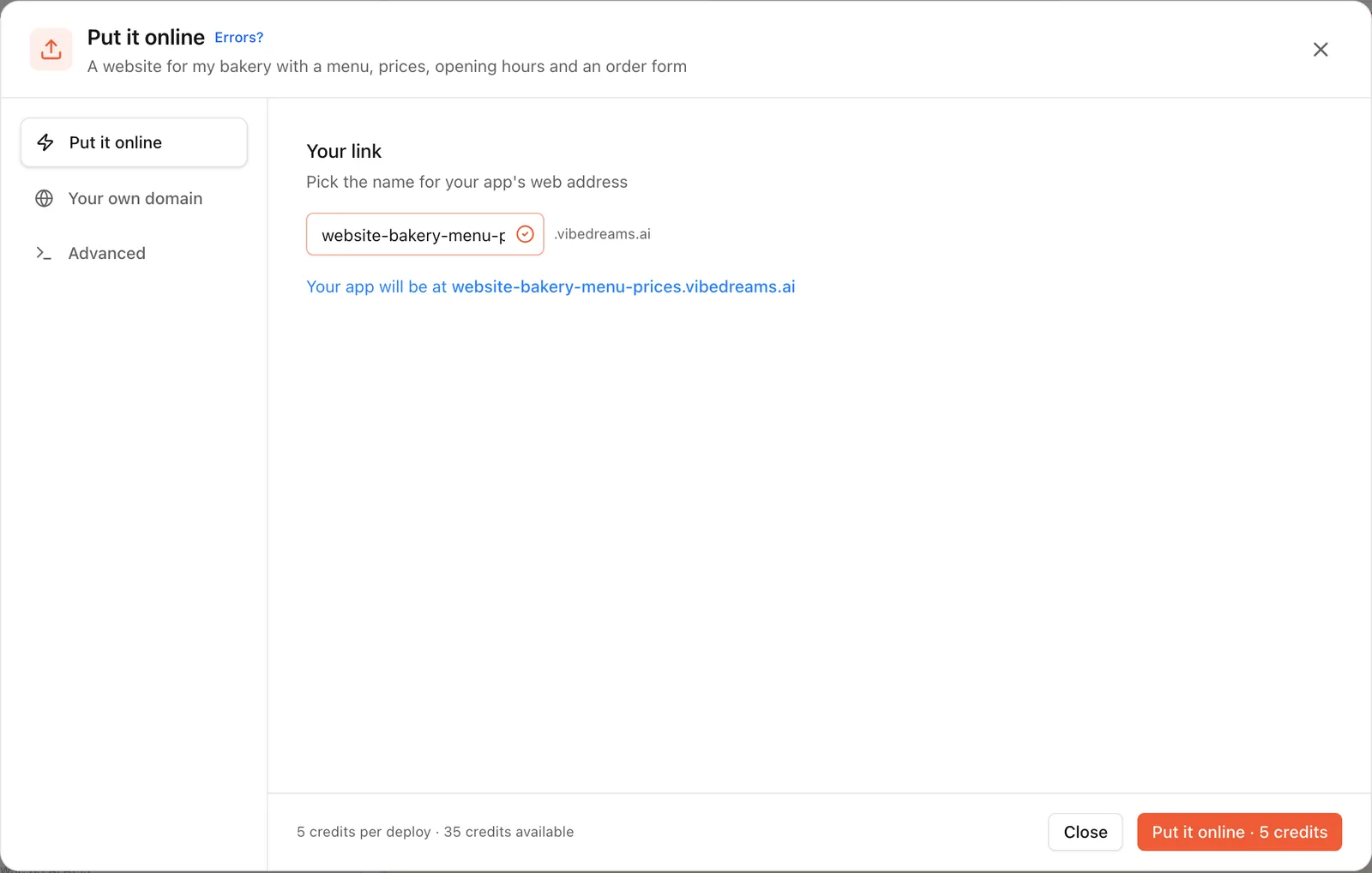
- Put it online: usually 1 to 3 minutes on VibeDream, with HTTPS set up for you.
- Your own domain: add a TXT and a CNAME record at your registrar; VibeDream checks automatically, usually within 5 to 30 minutes.
That puts a simple, tested first version in the range of an afternoon to a day. Apps with many user types, payments or complex rules take longer, mostly because each needs careful testing.
Rough timelines by app type
Scope matters more than route. These ranges assume a focused first version and someone who makes decisions quickly. They are planning guides, not promises.
- Waitlist or landing page with an email form: an hour or two with an AI builder or a template; a day or two with most other routes.
- Booking page for one business: an afternoon to a day with an AI builder; days with no-code; a few weeks with a freelancer.
- Personal tracker, such as habits, workouts or expenses: an afternoon with an AI builder; longer if you need charts and exports.
- Internal dashboard for a small team: a day or two with an AI builder, plus time to agree what the team actually needs to see.
- Simple browser game: an afternoon for a playable first version on VibeDream, which builds games with Phaser; tuning difficulty and feel takes as long as you let it.
- Marketplace with two user types, payments and reviews: weeks at least on any route, because of the rules, edge cases and testing.
- Native iPhone and Android apps with accounts and payments: months with a developer or agency, plus store review.
If your idea sits at the bottom of this list, consider launching the top-of-the-list version first, such as a waitlist that proves demand while you build the rest.
What slows projects down
These cause delays on every route, from agencies to AI builders.
- An unclear idea. Changing what the app is halfway through costs more time than anything else.
- Scope creep. "While we are at it" features add up quickly.
- Waiting on content: copy, photos, prices and legal text.
- Slow feedback. Every review round that waits a week adds a week.
- Integrations. Payment providers, email senders and older systems each come with setup, keys and edge cases.
- App store review for native apps, including rejections.
- Security and data rules, which need testing with real accounts.
- DNS and domains, which occasionally take longer than expected to settle.
How to finish faster
- Write a one-page brief before anything else.
- Build one core feature first and launch it.
- Start from a template where one fits, such as a landing or waitlist page.
- Gather your copy and images before you start.
- Choose a web app first; skip store reviews.
- Make decisions quickly and write them down.
- Batch your feedback into one clear list per round if you work with people, and one change per prompt if you work with AI.
- Put a rough version online early and let real users tell you what matters.