
Hire someone to build your app when it needs native mobile apps, complex rules, payments at scale, strict compliance or deep integrations, and you have a budget in the tens of thousands. Build it yourself when it is a web app with a clear core feature, your budget is small, and you want to learn quickly whether people will use it. Many founders do both: build a working first version themselves with an AI app builder, prove demand, then hire a developer to take the exported code further.
What your budget buys
- Under a few hundred dollars: build it yourself with an AI app builder or no-code platform. Hiring is not realistic at this level for a custom app.
- A few hundred to a few thousand: build it yourself, then pay a freelancer for specific jobs such as a security review, a payment integration or design polish.
- $10,000 to $50,000: the range where Clutch says most agency app projects fall. Enough for a focused custom app from an agency or a strong freelancer.
- Above that: agencies or a small in-house team, especially for native apps on both platforms, many integrations or regulated data.
What freelancers and agencies charge
Clutch's app development pricing guide, updated 21 September 2026 and based on projects reviewed on its platform, gives a useful anchor. Our app cost guide has the full breakdown.
- Most projects cost between $10,000 and $49,999.
- Firms most commonly charge $25 to $49 an hour, so the hours in a quote matter as much as the rate.
Freelance rates vary even more by country and experience, and quotes for the same brief can be several times apart. That is why comparing quotes only works against the same written brief.
What usually is and is not included:
- Usually included: design, development, basic testing and launch.
- Often extra: app store submission, hosting setup, analytics, content entry, and support after launch.
- Almost always extra: new features after the agreed scope, and ongoing maintenance, which many teams budget yearly.
Freelancer or agency
If you decide to hire, the next choice is who.
- A freelancer is usually cheaper and talks to you directly. The risk is that one person covers design, code, testing and hosting, and if they get busy or ill, the project stops. Good for focused jobs and small apps.
- An agency brings a team: a project manager, designers, developers and testers. You pay for that structure, and you get continuity and a process. Good for larger apps, native apps on two platforms and projects with fixed deadlines.
- A technical cofounder shares the risk and the reward. That is a different conversation about equity and commitment, not a purchase.
Whichever you choose, start with a small paid first milestone, such as a clickable design or one working feature. You learn how they communicate and how they handle feedback before committing the whole budget.
How to write a brief
A good brief gets you better quotes and fewer surprises. One or two pages is enough.
- The problem: who has it and how they deal with it today.
- The users: each type, such as customers and admins, and what each must be able to do.
- The core flow: the one journey that must work perfectly, step by step.
- Screens: a list, with rough sketches or screenshots of apps you like.
- Must-haves and nice-to-haves, in two separate lists.
- Platforms: web, iPhone, Android, or web first.
- Integrations: payments, email, maps, existing systems.
- Data: what you store, and anything sensitive.
- Budget range and deadline.
- Ownership: you own the code, the accounts and the domain.
A working prototype is the best brief of all. Developers can click through it instead of guessing from text, and their quotes get tighter because there is less to imagine.
Red flags
- A quote with no questions asked. Good developers ask a lot before pricing.
- No written scope, milestones or acceptance criteria.
- All payment up front.
- They keep the code, hosting or domain in their own accounts.
- No access to the code until the end.
- No mention of testing, security or what happens after launch.
- A portfolio you cannot verify, with no live apps to try.
- A promise that a complex app will be ready in days.
Ask for milestone-based payments, weekly demos and access to the code repository from the first week.
When to build it yourself with AI
Building it yourself makes sense more often than it used to.
- It is a web app with a clear core action: booking, tracking, a directory, a dashboard, a waitlist.
- You need to test demand before spending thousands.
- You want to change things daily based on feedback.
- Your budget is a monthly subscription, not a project fee.
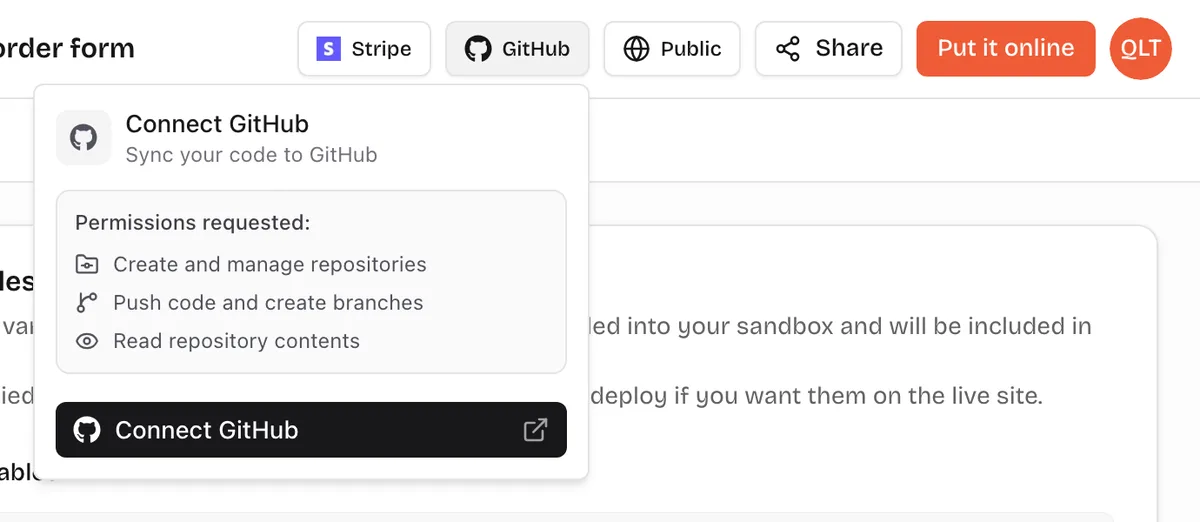
With an AI app builder like VibeDream, you describe the app by typing, talking or attaching a sketch, and get a React + FastAPI app in a live preview. Change it by chatting, then tap Put it online to publish to a vibedreams.ai address with HTTPS, for 5 credits per publish. Plans start at $49 a month for 60 credits; there is no free plan. You can connect your own domain with a TXT and a CNAME record, and you own the code: download it as a ZIP or sync it to GitHub.
What you still own as the builder: the decisions, the testing and the security checks. On VibeDream, built-in login and database work with one tap, and one-tap payments are coming soon. Real card payments today use your own Stripe account.
Hybrid, build the MVP, then hire
This route often gives you the best of both.
- Build the first version yourself with AI and put it online.
- Get it in front of real users. Measure the one number that matters, such as bookings or repeat visits.
- When the numbers justify it, hire a developer. Give them the live app, the exported code on GitHub and a list of what users asked for.
- Ask them first for a review: security, data rules, performance and anything to refactor.
- Then hire them for specific improvements, or native apps, with the web app as the living spec.
You spend money only after you know what to spend it on, and the developer starts from something real instead of a blank page. Because VibeDream projects are standard React and FastAPI code, most web developers can pick them up quickly.
Questions to ask any developer you hire
- Can I see two or three live apps you built, and talk to those clients?
- How do you handle changes to the scope?
- How will you test the app, and who tests it on real phones?
- Where will the code, hosting and domain live, and in whose name?
- What happens after launch, and what does support cost?
- How do you handle security and personal data?
- Will you work from my existing code, if I already have a prototype?