
Astrocade AI is a platform where you make games by describing them to an AI and play games other people made, all in one feed. It is free to use, it is built around remixing, and it suits anyone who wants players and quick fun more than control over files and hosting. This Astrocade AI review is about the AI game platform at astrocade.com, not the Bally Astrocade, the home console from the late 1970s that shares the name.
Checked: Oct 2026. Facts below come from Astrocade's own site, its July 2025 launch announcement and May 2026 funding coverage, read on 25 October 2026. We did not build a game on Astrocade for this review. Where Astrocade does not publish something, such as a price list, we say so.
The short verdict
Astrocade is the most social of the AI game makers. Its homepage headline is Play Free Online Games or Create Your Own with AI, and the product follows that order: you land in a feed of games, and making your own is one tap away. Remixing is the core idea, so a good game spreads by being copied and changed.
That is also the limit. Your game lives inside Astrocade. We found no code export, no custom domain and no way to place the game in your own site on its official pages. If you want a game you can put on your own address, connect to a website or keep in GitHub, a builder you host yourself is the better fit.
What Astrocade is and who is behind it
Astrocade was founded by brothers Amir and Ali Sadeghian. On 30 July 2025 it announced a relaunch built around an AI agent for game creation, with AI-guided brainstorming, custom in-game editors and what it called deep remix features. Later company material names that agent AstroBrain.
In May 2026, PocketGamer.biz reported that Astrocade had raised $56 million across a Series A led by Sea and a Series B led by Sequoia Capital, with Google's AI Futures Fund and Nvidia among other investors. The company says it passed 20 million users within eight months of launch. Fortune's coverage of the same round put it at about five million monthly active users and more than 75,000 games. Both figures come from the company, and we have not verified them.
How making a game on Astrocade works
From what Astrocade publishes, the flow looks like this:
- Start in Create. You describe a game idea, or brainstorm with the agent if you only have half an idea. The July 2025 announcement says the brainstorming step can turn a rough concept into a game blueprint.
- The agent builds a playable game. You refine it with more prompts and with the in-game editors.
- Publish to the feed. The homepage opens on a Popular section of games, each credited to its maker.
- Others remix it. The launch announcement says every game can be cloned, tweaked and re-shared.
- Come back to it. The site's main menu is short: Home, My Arcade, Create and Profile, plus a Get App link.
We have not yet run a timed build on Astrocade for this review, so we will not show screenshots or a time we did not measure. The test section below shows exactly how to run one yourself.
What Astrocade costs
Astrocade presents itself as free: the homepage says Play Free Online Games, and making games is open to anyone with an account. When we checked, astrocade.com/pricing returned a 404 and we found no official paid plan for creators. Some third-party sites list paid tiers, but none of them linked to an official source, so we are not repeating those numbers.
What Astrocade does well
- Built-in audience. Your game goes straight into a feed that people already browse, which is the hardest part of making a game for most people.
- Remix culture. Cloning and changing a game is a core feature, which makes it a great place to learn by copying.
- Low cost to try. You can make and play games without picking a plan.
- Help with the idea. The July 2025 announcement says the agent can turn a rough concept into a game blueprint before it builds anything.
- Mobile. The site has a Get App link as well as the browser version, so playing on a phone is the normal case.
Where Astrocade stops
- No ownership trail we could find. We found no code export on Astrocade's official pages. If you want the files, you cannot assume you can get them.
- No custom domain. Games live on Astrocade. There is no way listed to put a game on your own address or inside your own website.
- Remixing cuts both ways. Anything popular will be cloned. That is the design, but it is not a fit for a game you want to keep unique.
- Not for apps. Astrocade makes games. A quiz that also collects sign-ups, a game on a business site or a game with a shop around it needs a different tool.
- Unclear pricing. With no official price list, it is hard to know what heavier use will cost later.
Astrocade vs VibeDream
VibeDream is an AI builder for apps and games. Games are built with Phaser, the open source HTML5 framework, are portrait first and have touch controls built in. Apps are built with React and FastAPI. The two tools agree that games should be quick to make and fun to share. They disagree about where the game lives.
- Where your game lives: on Astrocade, in its feed. On VibeDream, at your own link. Put it online gives a vibedreams.ai address, and you can connect your own domain with a TXT and a CNAME record. HTTPS is set up automatically.
- Sharing: Astrocade has a feed and remix. VibeDream gives each game a play page with a top scores leaderboard, and signed-in players can remix it into their own copy.
- Code: VibeDream lets you see the code, download it as a ZIP, or sync it to GitHub. We found no code export on Astrocade.
- Apps: VibeDream builds web apps as well, so a game can sit next to a landing page or a site you make in the same place. See the templates for app starting points.
- Price: Astrocade is free to use. VibeDream has no free plan. All Access Mini is $49 a month with 60 credits and All Access is $97 a month with 150 credits. See pricing.
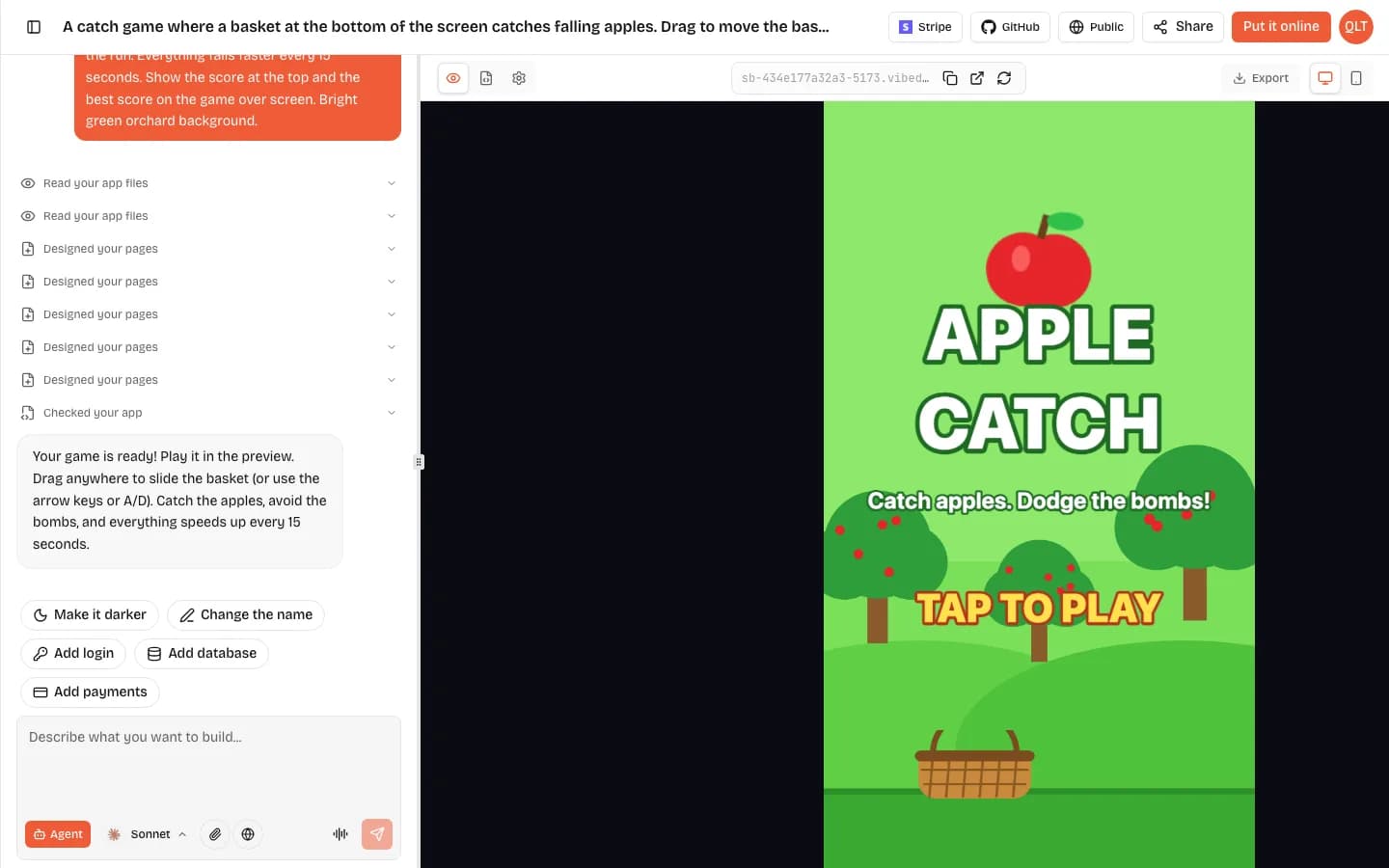
On the VibeDream side we did run a test. A catch game prompt on 25 October 2026 was playable in about 70 seconds and used 7 credits. Once a VibeDream game is put online it is an ordinary web page at its own address, and that is the real difference from Astrocade's feed.
If what you want is players, start on Astrocade. If what you want is your game on your own address, or a game that is part of something bigger, VibeDream is built for that.
Test Astrocade yourself with one prompt
The fairest review is the one you run. Use the same prompt on Astrocade and any other tool, and compare on the same phone.
- Prompt: a matching game with 12 cards showing fruit, flip two at a time, count moves, and show a well done screen with the number of moves.
- Time it from pressing build to the first round you can play.
- Ask for one change: make it 16 cards and add a 60 second timer.
- Publish and open the link in a private window to see what a new player sees.
- Try to get the game onto a page you control. Note what each tool lets you do.
Our matching game maker guide shows this same game built on VibeDream.
Who should pick something else
- You want the game on your own site or domain: pick a builder that lets you host, such as VibeDream, or write it in Phaser yourself.
- You want 3D or generated sprites and models: look at Rosebud AI. Our Rosebud AI review covers its plans.
- You want an app store release: an engine like GDevelop exports to Android, iOS and desktop.
- You want the widest set of options in one table: see Rosebud AI alternatives.
Our take
Astrocade is a strong place to make a quick AI game and get it in front of players, with remixing that makes the whole platform feel alive. It is a weaker choice the moment you care about owning the game: your files, your address, your page. Try it for fun, and if a game takes off, think about where you want its long-term home to be.